
What a K-Shaped Economy Means for Small Business Owners
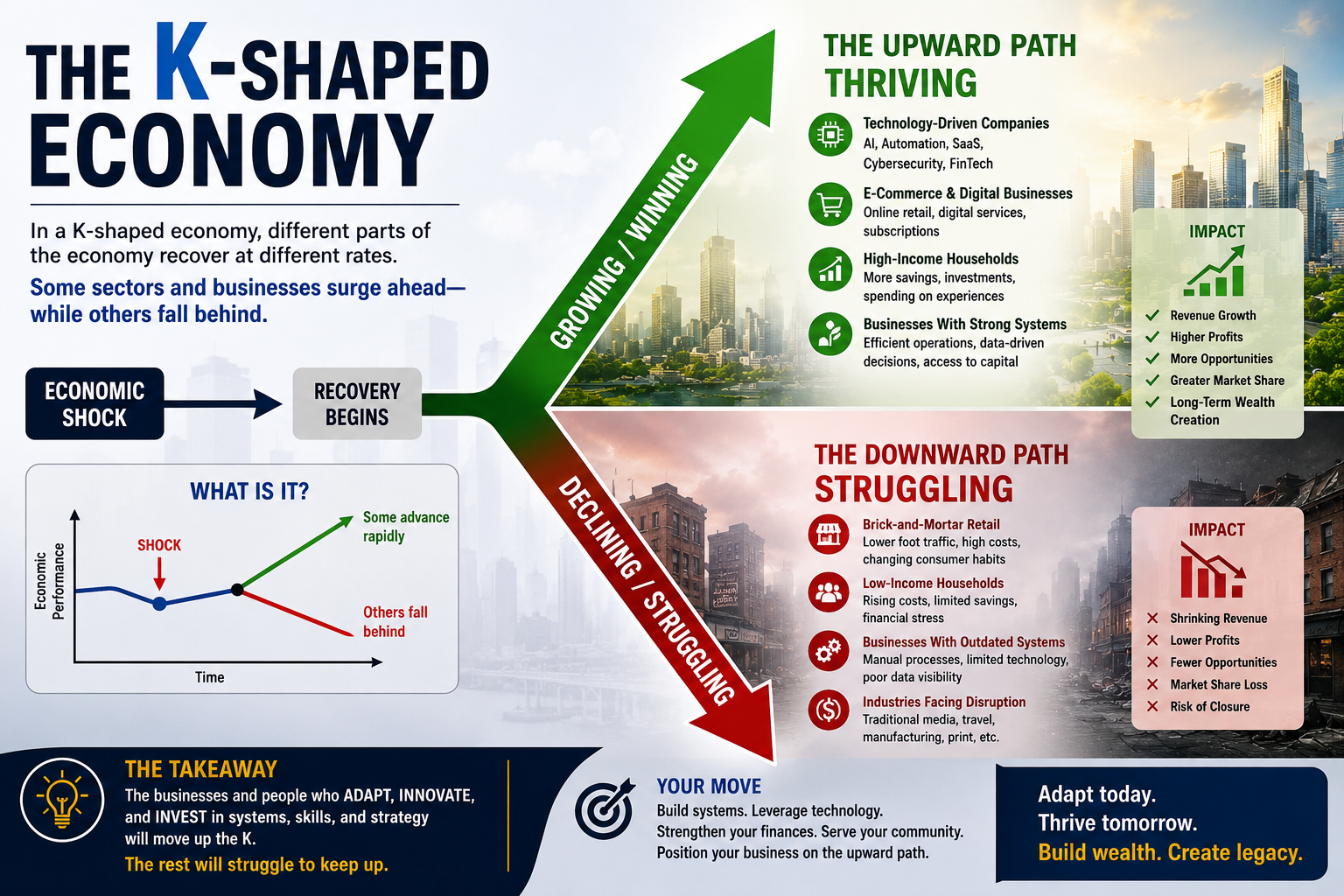
A K-shaped economy is an economic recovery or market condition where different groups of people, industries, and businesses move in two very different directions at the same time.
Some businesses and individuals go upward (growth, wealth, expansion), while others go downward (declining revenue, debt, closures, instability).
The shape of the letter “K” represents this split:
The upper line = businesses and people accelerating upward
The lower line = businesses and people falling behind
This became very visible after COVID-19, the rise of AI, automation, inflation, and digital transformation.
What a K-Shaped Economy Means for Small Business Owners
Businesses Moving Upward (Top of the “K”)
These businesses usually:
Use technology and AI
Operate efficiently
Have strong systems and automation
Build recurring revenue
Adapt quickly
Leverage digital marketing and data
Access capital and partnerships
Focus on scalability
Examples:
AI-powered service businesses
E-commerce brands
Managed service providers
Financial technology firms
Digital agencies
Healthcare and wellness tech
Cybersecurity and cloud companies
These businesses often:
Grow faster
Gain market share
Increase profits
Operate leaner
Expand nationally
Businesses Moving Downward (Bottom of the “K”)
These businesses often:
Depend only on foot traffic
Operate manually
Lack systems and automation
Have poor financial visibility
Avoid technology
Depend on one income stream
Struggle with inflation and labor costs
Cannot adapt quickly
Examples:
Traditional retail with no online presence
Businesses without digital systems
Companies with outdated operations
Businesses heavily dependent on unstable local spending
These businesses may experience:
Shrinking profits
Higher operational costs
Cash flow instability
Difficulty accessing capital
Burnout and survival-mode operations
Major Impacts on Small Business Owners
1. Technology Gap Widens
Businesses using:
AI
Automation
CRM systems
Financial dashboards
Digital marketing
Business intelligence
…will outperform businesses still operating manually.
This creates a digital divide.
2. Cash Flow Will Matter More Than Ever
In a K-shaped economy:
Revenue may become unpredictable
Consumers become more selective
Lending tightens
Costs rise
Businesses without:
reserves,
systems,
forecasting,
or operational efficiency
…become vulnerable quickly.
3. The Middle Gets Squeezed
Many small businesses will either:
evolve and scale upward,
ORstruggle to survive
There will be less room for businesses operating without:
strategy,
data,
systems,
positioning,
or innovation.
4. Consumers Become Split Too
Customers also divide into two groups:
Higher-income consumers spending on convenience, premium services, experiences, and technology
Lower-income consumers focusing on affordability and essentials
Small businesses must understand:
Who they serve
Their pricing strategy
Their market positioning
How Small Business Owners Can Thrive in a K-Shaped Economy
1. Build Systems, Not Just a Business
The businesses that thrive will operate like systems.
Focus on:
Automation
Standard operating procedures
CRM platforms
Financial systems
AI tools
Operational workflows
2. Use AI as a Force Multiplier
AI helps small businesses:
reduce labor costs,
improve marketing,
automate customer support,
analyze data,
generate content,
improve sales processes,
and increase productivity.
AI can allow a 3-person business to compete like a 20-person company.
3. Create Multiple Revenue Streams
Businesses relying on only one income source are more vulnerable.
Strong businesses diversify through:
subscriptions
consulting
digital products
memberships
affiliate partnerships
recurring services
licensing
training programs
4. Focus on Operational Efficiency
Profitability matters more than just revenue.
Winning businesses monitor:
customer acquisition cost
retention
margins
productivity
automation
fulfillment efficiency
The goal is:
“Do more with less while increasing value.”
5. Become Financially Intelligent
Small business owners must understand:
cash flow
funding readiness
credit positioning
debt structure
forecasting
business valuation
Programs like the Black and Brown Founders Inc. BizScoreLine Assessment and BBF Smart Money Program are designed around helping founders become more financially prepared and sustainable.
6. Build Strategic Partnerships
In a K-shaped economy, ecosystems outperform isolated businesses.
Partnerships can help businesses gain:
distribution
technology access
customers
capital
credibility
operational support
This is why:
banks,
fintechs,
nonprofits,
AI companies,
and business support organizations
…are increasingly collaborating.
7. Invest in Brand, Trust & Community
People buy from brands they trust.
Businesses that win long-term:
educate their audience,
build communities,
provide value consistently,
and create emotional connection.
Community-driven businesses often survive downturns better.
The Biggest Opportunity in a K-Shaped Economy
The biggest opportunity is this:
Small businesses that embrace systems, AI, operational excellence, and financial intelligence can scale faster than ever before.
The businesses that adapt can:
gain market share,
operate leaner,
serve nationally,
and create long-term wealth.
Final Perspective
A K-shaped economy is not just about survival anymore.
It is about:
adaptability,
systems,
technology,
resilience,
operational intelligence,
and strategic positioning.
Small business owners who:
evolve,
modernize,
leverage AI,
build infrastructure,
and think long-term
…can move upward on the “K” and create sustainable growth, ownership, and generational wealth.